3D Printing of Engineered Materials in Microgravity
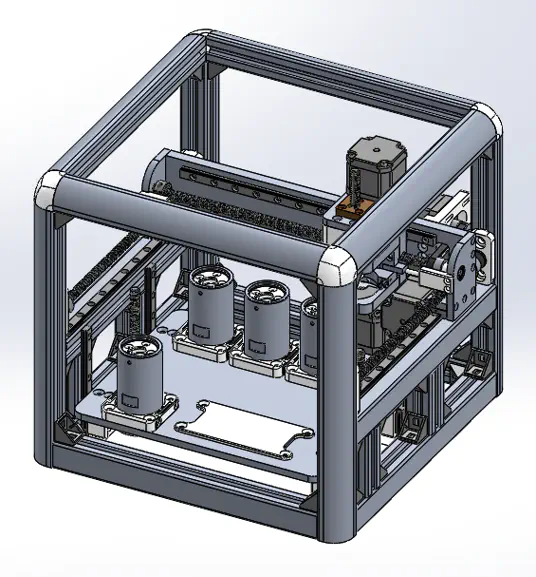 CAD model of the printer
Team SenseAid designed and constructed a 3D printer for engineered materials under microgravity conditions.
The NASA Artemis program plans to return humans to the Moon on a series of long-term missions. Replacement parts, materials research samples, and protective coatings will need to be manufactured on these missions in lieu of resupplies. In-situ 3D printing is being explored as a weight- and space-efficient alternative to traditional manufacturing methods like casting or machining. There exist current implementations of 3D printing in orbit aboard the ISS, such as Redwire, Inc.'s Additive Manufacturing Facility [1]; These attempts are limited to established thermoset printer inks like polymers and simple photosets [1] [2]. Printed materials in space may require engineered properties such as fatigue, radiation, and vacuum resistance; Precluding many traditional inks. [3] Additionally, the powdered regolith of the Moon’s surface poses a near-endless supply if adapted as a printer ink, saving valuable weight at launch. [4] The high melting temperature of regolith makes thermoset print methods inviable. [5]
Team SenseAid worked closely with UCF's Raghavan Research Group (PI: Dr. Seetha Raghavan) and Co-Advisor Perla Latorre Suarez to prototype a 3D printer capable of gravity and microgravity printing across the widest possible range of engineered materials. The printed ink is a composite of photoset resin and a volume fraction of additives containing the desired engineered properties of the print. Innovations in the Direct Ink Write (DIW) print method make the printer capable of space operation. Consideration was given to forward compatibility for parabolic flight testing and ultimately in-orbit operation on the ISS EXPRESS Racks. [6] The completed printer has added functionality in automatically swapping inks, enabling multi-ink prints without human interaction.
The project was a success and the brief demo can be found in the project slides. The project was funded by NASA MINDS, a senior student design competition. This project’s submittables consisted of a poster, live presentation, and a 'Systems Engineering Paper' on the project-level details. See links at top for each document. Team SenseAid earned 1st prize for poster, 3rd prize for Systems Engineering Paper, and 1st prize overall for a total of $5500 winnings.
[1] Made In Space, “Additive Manufacturing Facility: 3D Printing The Future in Space,” 20 March 2019. [Online]. Available: https://medium.com/made-in-space/additive-manufacturing-facility-3d-printing-the-future-in-space-a800fccecdf3.
[2] A. Strömbergsson, “New microgravity AM technique uses pre-ceramic resins and SLA on the ISS,” 3D Printing Media Network, 2 December 2020. [Online]. Available: https://www.3dprintingmedia.network/new-microgravity-am-technique-uses-pre-ceramic-resins-and-sla/.
[3] T. Ghidini, “Materials for space exploration and settlement,” Nature Materials, vol. 17, pp. 846-850, 2018.
[4] V. Listek, “Redwire ISS Experiment Targets In-Space 3D Printing with Lunar Regolith,” 3DPrint.com, 13 July 2021. [Online]. Available: https://3dprint.com/283206/redwire-iss-experiment-targets-in-space-3d-printing-with-lunar-regolith/.
[5] A. J. Collaza, Analysis of Lunar Regolith Thermal Energy Storage, Ohio: NASA, Brook Park, 1991.
[6] A. Sledd, M. Danford and B. Key, “EXPRESS Rack: the extension of International Space Station resources for multi-discipline subrack payloads,” in IEEE Aerospace Conference Proceedings, Big SKy, MT, 2003.

Dylan Lyon
Scientist I
Scientist at LANL. Masters in mechanical engineering from the University of Michigan - Ann Arbor. Bachelor’s in aerospace engineering from the University of Central Florida. Likes cooking; mediocre cook.